Monthly financial tracker
My role
Product Designer
Timeline
12 weeks
Platform
Mobile (iOS & Android)
Core challenge
The app had a strong value proposition during tax season — but outside of it, engagement dropped off sharply. Trial-to-subscription conversion sat at 30%, and only 40% of active subscribers opened the app at least once a month. The product was useful once a year. The challenge was making it indispensable year-round.
Mindset
I took the lead on design and research, working closely with the product manager, two engineers, a data scientist, and a content writer over three months. Before jumping to solutions, I wanted to understand why freelancers weren't engaging outside tax season whether it was a feature gap, a motivation gap, or something else entirely. That distinction mattered, because it would determine whether we needed to build something new or reframe what already existed.
Investigation
I orchestrated the entire user research process for this project, overseeing planning, recruitment, execution, and insight derivation. My objective was to delve into the goals, needs, and pain points of users as they navigate the realms of taxes and finances.
The overarching business goal is to consistently deliver substantial value to users throughout the year by addressing their ongoing needs.
Research Method
Generative Research
Interview Type
Online 1 on 1
User Interviewed
6 freelancers
Demography
USA
Key insights
Taxes feel seasonal
Users viewed tax preparation as a once-a-year event, not an ongoing habit even when they understood the financial benefit of tracking deductions throughout the year.
Budgeting felt like a separate problem
Users wanted visibility into their cash flow and financial health, but saw that as distinct from tax management. The app wasn't bridging the two.
Too many tools, no single source of truth
Users were juggling Mint, Everydollar, Stash, spreadsheets & then manually stitching the data together at tax time. It was exhausting and error-prone.
Tax estimation is tough
Calculating quarterly tax obligations without guidance left users anxious and disengaged. They wanted help, not just data.
Goal
“How might we enable freelancers to manage their finances effectively throughout the year — so that tax season is a summary, not a scramble?”
Solution
A financial tracking feature built around the MVP mindset delivering real user value without losing the product's identity as a tax-first app.
A sneak peek
After countless brainstorming sessions and iterations, we've crafted a solution that perfectly aligns with our goals and design principles.
Onboarding
Rather than gating the feature behind a dedicated onboarding flow, I introduced an unobtrusive bottom sheet to announce its launch. A persistent home page widget kept it discoverable even after dismissal — so users who ignored it the first time would encounter it naturally, without feeling pushed.
Swipe to categorise
Implemented swipe interactions for accepting and rejecting income entries — similar to the pattern Tinder made familiar. Swiping is more precise than tapping for binary decisions, and it reduces the chance of accidental miscategorisation. A small detail, but it made a meaningful difference to data accuracy.
Progress visibility
Displaying a user's current completion status and what remained reduced the psychological weight of the task. Knowing that most of the work was already done motivated users to finish rather than abandon.
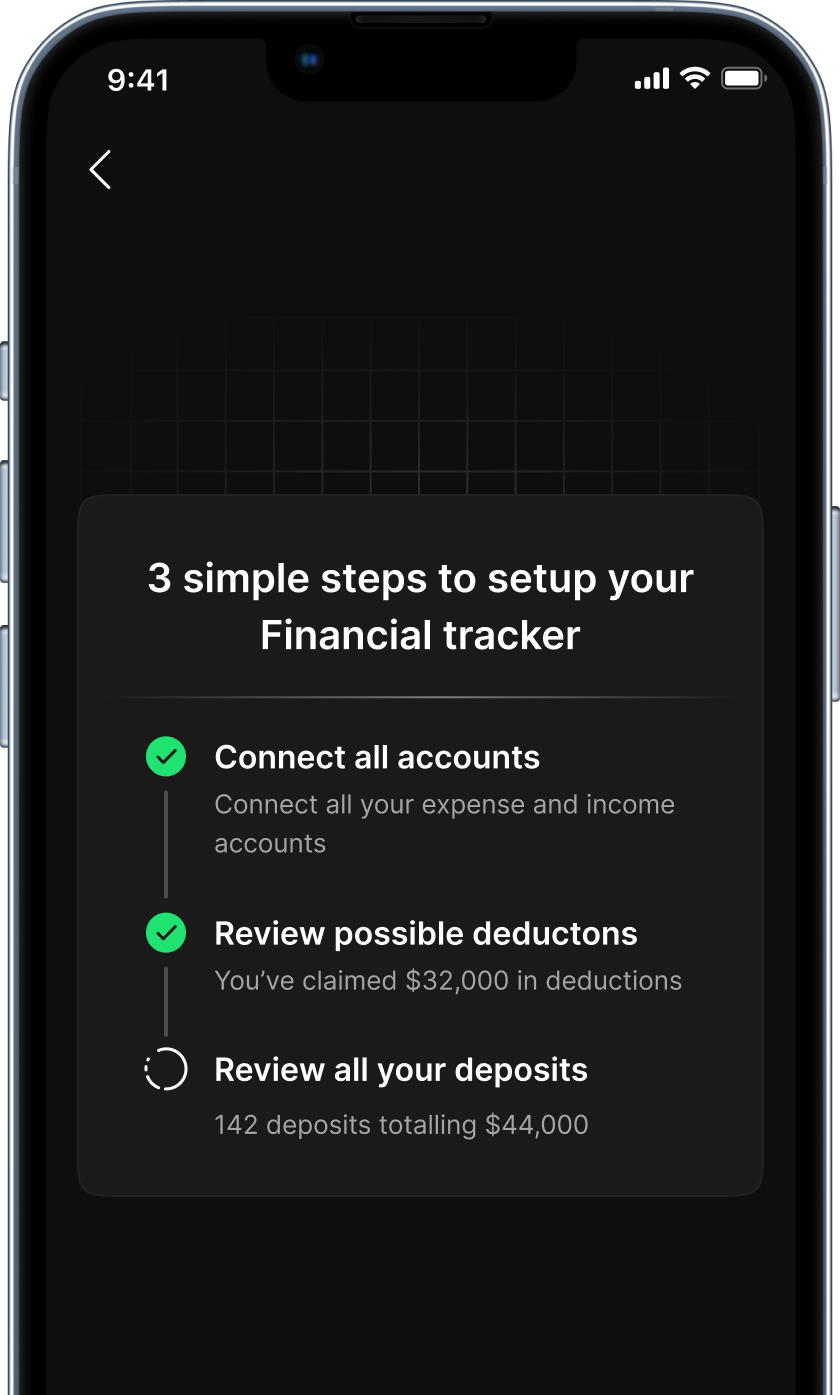
Show status
Showing the total detected deposits up front gave users a clear picture of what connecting each account would unlock. It reduced surprise later and created a stronger incentive to link everything from the start.
Result & impact
Three months post-launch (Aug–Nov 2023), the data showed meaningful movement across every key metric:
increase in monthly active subscribers.
rise in trial-to-subscription conversion.
increase in average sessions per user.